EvaluationRegulatory AlertAlex Mariano4 min read
2027 Passive Renewals: Why CMS May Strip Your NPN and How to Protect Your Book
Your clients may stay insured, but you will lose your commission and Agent of Record status. Here is what the new CMS auto-renewal verification rule means and how to respond.
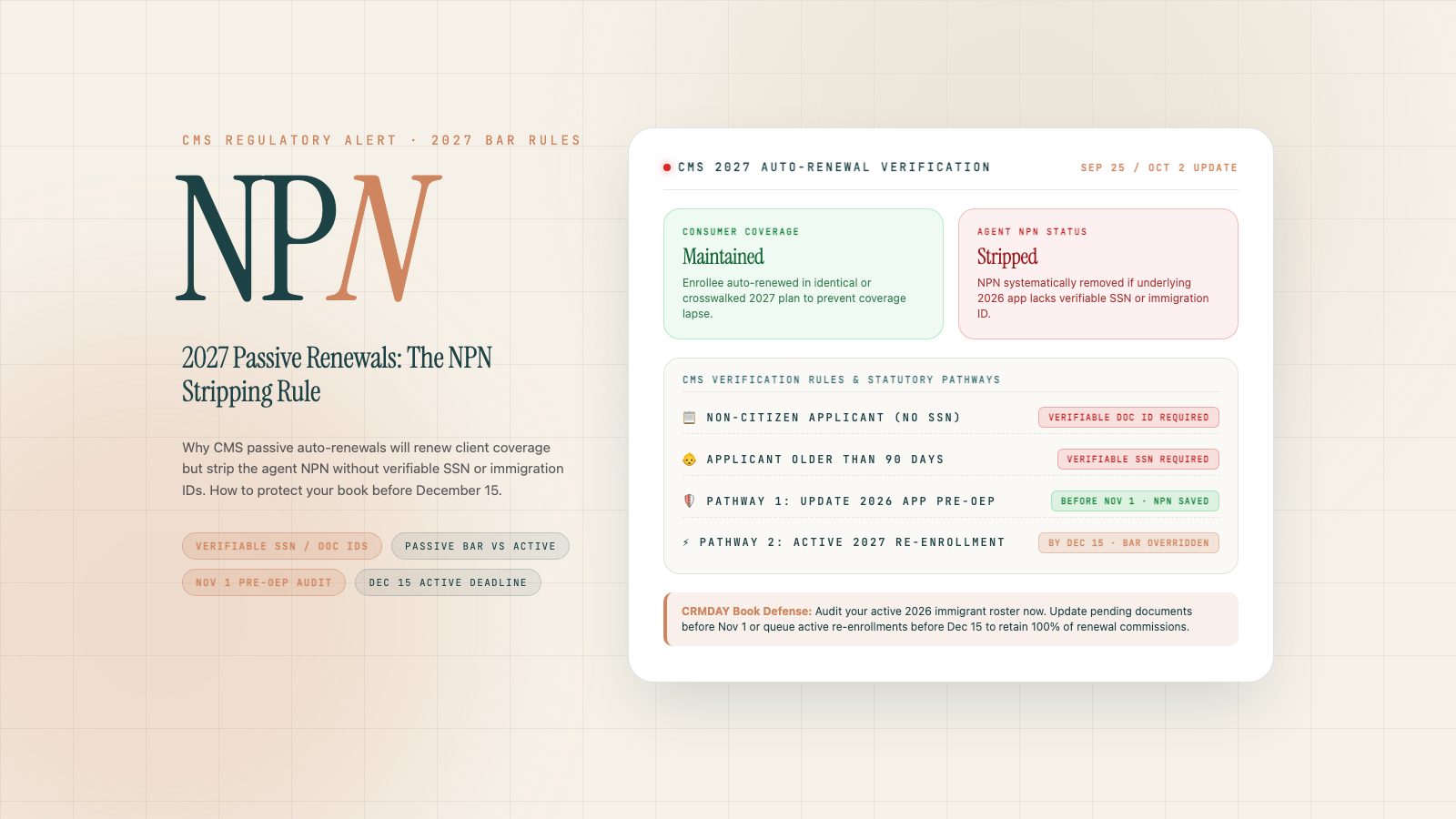
On October 2, 2026, HealthSherpa updated its official renewal guidance, detailing an urgent operational consequence of CMS's new verification requirements for Plan Year 2027. The core takeaway represents a massive financial risk for every ACA brokerage: passive automatic renewals (Batch Auto Re-enrollment or BAR) will continue to renew client coverage, but CMS will systematically strip the agent National Producer Number (NPN) from the 2027 policy if the underlying application lacks verifiable documentation.
This guidance follows CMS's official bulletin issued on September 25, 2026, confirming that federal marketplace algorithms will verify every auto-renewed application carrying an agent NPN. If the application does not have a verifiable Social Security Number (SSN) or a verifiable immigration document number for each applicable household member, the consumer will still be renewed to ensure continuous healthcare coverage, but the writing agent will be removed. The agency loses its Agent of Record (AOR) status, loses future renewal commissions, and loses visibility into the account.
The Immigrant Portfolio Impact: Where the Primary Risk Lies
This regulatory shift is particularly consequential for agencies serving immigrant communities. While citizens and lawful permanent residents typically provide an SSN, lawfully present immigrants: such as work visa holders, asylum applicants, humanitarian parolees, and Temporary Protected Status (TPS) recipients: frequently enroll using alien registration numbers, I-94 numbers, or card numbers.
CMS has specified that for any applicant who does not have an SSN, verifiable immigration document information must be present on the application. Furthermore, the September 25 bulletin clarified that applicants older than ninety days who have an SSN must have that number verified. In historical enrollment rushes, agents frequently submitted applications with minor typos, pending document placeholders, or unverified fields. Under passive renewal, those uncorrected errors will trigger automatic NPN removal.
In operational audits across agency clients using CRMDAY One, we identified that between 22% and 38% of active 2026 immigrant client profiles contained unverified immigration document fields or missing secondary identifiers. If left uncorrected prior to auto-renewal, those accounts represent immediate commission forfeiture.
The Two CMS Safeguard Deadlines: How to Defend Your NPN
CMS outlined two clear operational pathways for agencies to prevent NPN stripping on their 2027 book of business:
| Remediation Strategy | Action Required | Statutory Deadline | Operational Impact on NPN |
|---|---|---|---|
| Pathway 1: Pre-OEP 2026 Application Correction | Update the existing 2026 Marketplace application with verified SSN or immigration document IDs before Open Enrollment starts | Before November 1, 2026 | Enables clean Batch Auto Re-enrollment (BAR) where NPN is successfully retained on the 2027 policy |
| Pathway 2: Active 2027 Re-Enrollment | Engage the consumer directly to update their 2027 application and process an active re-enrollment with verified data | By December 15, 2026 | Overrides passive renewal; NPN is securely bound to the 2027 policy with January 1 effective date |
“Relying on passive auto-renewal has always been a lazy retention strategy, but for 2027 it has become financially fatal. If you do not actively touch your book and verify documentation before December 15, CMS will keep the client insured and give your commission away.”
Passive Renewal vs. Active Re-Enrollment: Operational Breakdown
Understanding the technical mechanics of the Federal Platform auto-enrollment process highlights why passive renewals create hidden agency churn:
| Operational Feature | Passive Renewal (CMS BAR) | Active Re-Enrollment (Agent-Led) |
|---|---|---|
| Consumer Coverage Status | Automatically maintained into identical or crosswalked plan | Actively verified and selected based on updated doctors and networks |
| NPN Retention Requirement | Stripped if any non-newborn applicant lacks verifiable SSN or immigration ID | Retained 100% when submitted with updated consent and verified identifiers |
| Income & APTC Accuracy | Rolled over from prior year; high risk of tax reconciliation surprises | Updated with current household MAGI, maximizing tax credit accuracy |
| Agent of Record Security | High vulnerability to NPN stripping or predator broker hijacking | Fully locked with timestamped consumer consent and active re-enrollment binder |
Want to identify unverified immigrant records and missing SSNs in your book before Open Enrollment? Explore CRMDAY Insurance CRM
The 3-Step Emergency Audit Protocol for Agency Owners
Every agency owner writing ACA business should immediately execute this three-step defense protocol across their active roster:
Step 1: Export & Audit Active 2026 Roster
Filter your CRM and HealthSherpa book for all non-citizen enrollees and applicants marked without a verified SSN or with pending document verification tags.
Step 2: Launch Automated Multichannel Outreach
Deploy conversational WhatsApp and SMS sequences inviting clients to submit their current work authorization, green card, or visa details before November 1.
Step 3: Schedule Active Re-Enrollment Consultations
For accounts that cannot be updated prior to November 1, place them into priority active re-enrollment queues to bind before the December 15 deadline.
Agency Owner Action Checklist: Protecting Your 2027 Commission Book
To protect your recurring revenue and ensure your agency remains the Agent of Record on every client, implement these technical safeguards immediately:
The era of passive, hands-off ACA renewals is officially over. CMS's September 25 bulletin and HealthSherpa's October 2 guidance make it clear that maintaining your book requires proactive data verification. Agencies that mobilize early will not only protect their existing commissions: they will capture thousands of orphaned policies from competitors who let their NPNs get stripped silently.
Next step
Test it with your own workflows.
Start a free trial with a sample of your book, or bring your questions to a conversation with our team.
Sources
- HealthSherpa Help Center — 2027 Marketplace Renewal Guidance & CMS Verification (Oct. 2026) (opens in a new tab)
- CMS CCIIO — Auto Re-enrollment Verification Bulletin (Sept. 25, 2026) (opens in a new tab)
- CMS — Consumer consent and application review requirements (FAQ) (opens in a new tab)
- HealthCare.gov — Dates and deadlines (opens in a new tab)
This article is for information only and reflects public information as of its publication date. It is not legal or tax advice. Confirm current rules with CMS, your state exchange and your carriers.